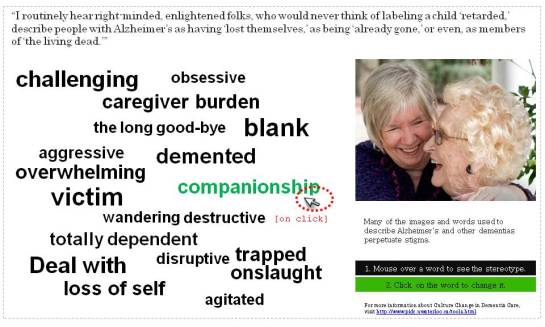
In thinking about our project and our hopes of helping to improve the language and culture around dementia, I began to think about the class’ early reading that I did my presentation on. “The Dorsal Turn,” from David Wills’ Dorsality: Thinking Back Through Technology and Politics, puts forth the proposition that humans were always from the outset technical beings. Wills posits that once we began to walk upright, we freed up our hands for tool use, and ultimately allowed for the development of a larger brain.

“What mobilizes itself in the technological turn is a function of something that cannot but occur, has already occurred, occurs automatically, is itself already in the service of a machine. The technological turn describes the turn into a technology that was always there” (3).

Much of what Wills argues has to do with the idea that human or “natural” and technological are intertwined from the beginning and that they are not actually separate things or states of being. The Dorsal Turn, among other things, seems to advocate a change in perception or “turn” towards the realization of this connection.

“[T]hey privilege the organic to the extent of failing to acknowledge the becoming-technological of biological self-organization or self-programation, whenever they ignore the originary mechanics at work in the evolution of the species. This is not to replace the organic with the mechanical but to argue against any rigorous purity of either” (6).

Wills furthers his argument about the human as technology—specifically a piece of biotechnology or biomechanics. As Wills points out, though, if we consider the human as technological and begin to consider a morality and ethics and future with that perception in mind it begins to change our thoughts and feelings about the increasing role of technology in our lives and bodies.

“Indeed, how could we begin to conceive of an ethics of the mechanical? Ethical behavior, political “choice,” free will, agency, indeed, the human itself are for us, by definition, representative of what breaks with mechanicity, automatism, or programmation” (6).

But as we continue to be influenced by the technologies we have created, supposedly outside of ourselves, we see that biological changes are occurring within us as a result of our use of “technology.” Technology has come from the back to surprise us.

As such technology becomes a real factor that should be considered philosophically and ethically when dealing with complex moral and socio-political problems. At this point it is important to realize that the technology I am thinking about is language and writing. Once we realize how much technologies can affect the development of the human species, it is important morally and ethically to consider the effects the development and use of technology (even language) can have on other people. Our language shapes our perceptions of everything in the world around us and has helped us make sense of abstract thought. It is a technology that has allowed us to achieve so much. Let’s wield it wisely.

“Such change, my argument goes, cannot be effected without tropological mediation: some idealized representations of an altered reality has to precede its implementation, or at least that is how political history, with its programs and manifestos, has proceeded.” (19)

Like Wills suggests, we seek to shoot for an idealized reality where people with Alzheimer’s and other dementias are recognized as people in the present and treated as such. A reality where they aren’t perceived through the use of negative and depersonalizing language as “mindless zombies” or “already gone.”

Wills, David. “The Dorsal Turn.” Dorsality: Thinking Back Through Technology and Politics. Minneapolis: U of Minnesota Press, 2008.
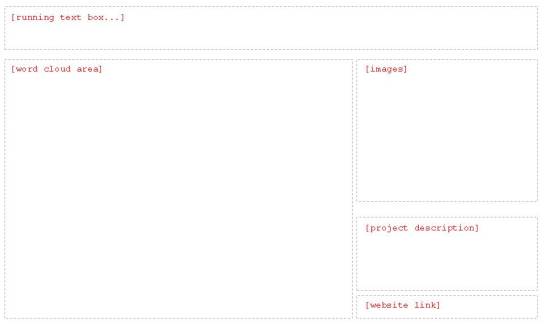


1. White backdrop; black-to-coloured text; three frames with interacting content.

2. On mouseover, black words correspond to an image and a sentence that contextualizes the negative language associated with dementia care.

3. On click, black words are replaced by coloured words (negative to positive language).

4. On mouseover, coloured words correspond to an image and a sentence that presents a different (positive) perception of dementia care and people living with dementia.

After reading Still Alice by Lisa Genova and participating in our class discussion, it seemed that Genova made Alice 50 years old to achieve maximum narrative impact and nothing more. It was quite effective to see someone who had so much going on, not that seniors don’t, have to deal with the life changes that an Alzheimer’s diagnosis brings. I began to wonder how many middle-aged adults (people below 65) are actually diagnosed with Alzheimer’s. It didn’t take long to find a news article that suggests that number is 15% of all people diagnosed with the disease. According to the Alzheimer’s society of Canada via the CBC, “Of the half-million Canadians affected by various forms of dementia, about 71,000 — or almost 15 per cent — are under age 65” and “about 50,000 are 59 or younger.” The CBC article also suggests that “As it stands today, the number of Canadians living with Alzheimer’s disease or a related dementia will more than double within a generation.” These are statistics that obviously demand attention from a political, economic, and social perspective.

http://www.cbc.ca/news/health/story/2009/01/05/alzheimer.html

Recently, we briefly mentioned that architecture is an object that may be used as a relatively stable inter-generational memory device. Indeed, collective memory is a popular topic in architectural theory.

An interesting integration of architecture, memory, and digital technologies is the website Memory Loops. The site combines recordings of memories of Nazi terror in Munich during 1933-1945 with their associated physical sites through mapping.

The creator of the project, Michaela Melián, will be giving a talk today, November 8, at 6:45 pm in the Lecture Theatre at the School of Architecture in Cambridge.

Another interesting place-based memory-recording project is Murmur, which collects recordings that are accessible on the website and via phone numbers posted on signage in locations relevant to the stories. The idea is that passers-by can use their cell phone to listen to someone’s memory of a place while in that place. The availability of memories both online and in-situ presents multiple modes of experience which are clearly different from each other.

The experience of “being there,” of presence, can intensify recall of memories. Since memory has a spatial component (thinking back to memory theatres and Quintilian’s story of Simonides in particular), the physical environment, including architecture, can have an important effect on memory. While architecture is normally thought of as a static thing, either unchanging or changing only slowly through incremental redevelopment, current practices treat many building types as much more temporary. Some buildings constructed today will have a lifespan of only 30 or 40 years. “Design for disassembly” is a sustainability strategy that involves designing buildings in such a way that when they are no longer useful, they can be disassembled into reusable parts. These approaches complicate the notion of the city as a reservoir of memory.

This week’s reading, Still Alice by Lisa Genova, describes the struggle between Alice, a woman who has been diagnosed with Alzheimer’s, and her husband when he considers relocating from Cambridge to New York for a job. The rest of Alice’s family believes that it would be better for her to remain in familiar surroundings, and Alice herself is unwilling to move. As her disease progresses, Alice finds that she is less comfortable in unfamiliar places, even her own vacation home. The situations presented in the novel also suggest a strong link between place and memory.

They are long overdue, but I thought I’d post these up anyway, in addition to the Blade Runner clip.


Plato. Phaedrus. Trans. Benjamin Jowett. Project Gutenberg. 30 Oct. 2008. Web. 21 Sept. 2012.

PHAEDRUS: What do you mean, my good Socrates? How can you imagine that my unpractised memory can do justice to an elaborate work, which the greatest rhetorician of the age spent a long time in composing. Indeed, I cannot; I would give a great deal if I could.

SOCRATES: I believe that I know Phaedrus about as well as I know myself, and I am very sure that the speech of Lysias was repeated to him, not once only, but again and again;—he insisted on hearing it many times over and Lysias was very willing to gratify him; at last, when nothing else would do, he got hold of the book, and looked at what he most wanted to see,—this occupied him during the whole morning;—and then when he was tired with sitting, he went out to take a walk, not until, by the dog, as I believe, he had simply learned by heart the entire discourse, unless it was unusually long, and he went to a place outside the wall that he might practise his lesson. There he saw a certain lover of discourse who had a similar weakness;—he saw and rejoiced; now thought he, ‘I shall have a partner in my revels.’ And he incited him to come and walk with him. But when the lover of discourse begged that he would repeat the tale, he gave himself airs and said, ‘No I cannot,’ as if he were indisposed; although, if the hearer had refused, he would sooner or later have been compelled by him to listen whether he would or no. Therefore, Phaedrus, bid him do at once what he will soon do whether bidden or not.

This passage is significant because it introduces, if not the literal analogy, the notion that speech is like a drug: Lysias’ speech inspires in Phaedrus a compulsive need, or addiction, to hear the same thing over and over, until, when that is no longer satisfactory, he needs the even stronger elixir of text to get his next fix. Going back to this early passage after reading Derrida’s “Plato’s Pharmacy,” it seems as if this link between text and pharmakon is established even earlier than Socrates’ mention of Pharmacia during his telling of the myth of Orithyia. A second significance is that Phaedrus went outside the wall to “practise his lesson,” as if this process was somehow extraneous, or supplemental, to what goes on in the city, just as the text is supplemental to logos in Derrida’s reading.

Read More

For anyone interested, UW professor Chris Eliasmith of the Centre for Theoretical Neuroscience will be giving a talk entitled “How to Build a Mind” on November 21, 3-5 pm in PAS 3026.

This might be an interesting look into a computational view of mind, something potentially relevant to both our research into dementia and the digitization of memory and other mental processes.

In other news, I will be posting a Processing “thingy” shortly, hopefully with a bit of an explanation about how the code works.

If you are still interested in reading the paper by Tristan Carter in the Archaeological Papers of the American Anthropological Association, you can view it here:

Carter, Tristan. “The Theatrics of Technology: Consuming Obsidian in the Early Cycladic Burial Arena.” Archaeological Papers of the American Anthropological Association 17.1 (2007): 88-107. Web. 15 October 2012.

Conversely, the leverage required to remove blades with the length and fine form of the necrolithic type involves a flaking instrument of some size, such that the force generated by the knapper is directed and transferred through a much longer flaking tool. This process would be far more flamboyant in terms of physical enactment and grandiose with regard to the space within which the knapper, flaking tool, and nucleus interacted, providing the audience with a true performance, a theatrics of technology, and a far greater visual stimulus than the technological mechanism first described. (94)

(i) The mechanism first described by Carter, in contrast to the process above, is normal knapping of standard sized obsidian blades; the practice took up little space and focused only on the perceptions of the craftsperson.

(ii) What does visual stimulus achieve within the context of Cycladic social structures?

Aristotle: memory is imprinted, witnessing imprints knowledge.

Aristotle on remembering and recollecting: How significant is this difference if memory is embodied? If rote patterns constitute remembering (physical, biological, bodily, animal) and recollecting is an intentional search for memories, and acknowledging the passage of time, the embodied nature of the technological theatre crashes the two together. These communities assuredly remembered the burial arena physically, knew the ritual patterns from multiple burials in their lifetimes, but they also recollected personhood and social differentiation, and communal values through the same arena.

Moreover, it seems quite clear that pressure-flaked blade manufacture was one of a number of crafts whose preferential consumption formed a component in the construction of social difference at the EBII “trader sites.” (96)

(i) John Durham Peters: The subject only expresses itself via objects. The blade manufacture was a medium for communicating social difference; a public sign with variable meaning. A number of other objects, like intense pigments, boat iconography and carved figurines in these island communities act in the same way.

(ii) The object, embedded within a framework (funerary rites) is the thing that realigns social being after a disruption (death); around it forms circuits of communication with the dead based on the senses.

Not everything I wanted to consider made it into my discussion last Thursday, so here are some excerpts from my reading notes. Please share your comments, and if you haven’t read, but would like to read, the John Durham Peters text, you can view it here:

Peters, John Durham. “Phantasms of the Living, Dialogues with the Dead.” Speaking into the Air: A History of the Idea of Communication. Chicago: University of Chicago Press, 2001. 137-176. Print.

Eros seeks to span the miles, reach into the grave, and bridge all the chasms. It is the principle that seeks to transcend the limitations of our normal modes of contact with each other in word and in the flesh. (137)

(i) Eros, the Greek romantic or sexual love, connotes wanting, implies desire for something, perhaps even though that thing requires us to span distance and death.

(ii) Thoughts on media archaeology: Eros might be the principle that drives new media technologies that Peters is tracing back to, to build the idea around the development of communication media from face-to-face speech (embodied), to writing (disembodied), to new media like photography and phonography, (disembodied but sensorily active, imitating presence, establishing communication with the absent) so that the theme of haunting comes fully into the chapter.

The Greeks took as natural facts the limited range of the human voice and the weakness of memory. Memory and writing were the only record. Writing, by making possible remote control over other bodies and voices (of readers) and the preservation of thoughts (of the writer), made possible a new order of polygamous coupling among souls. The far could now speak to the near, and the dead could now speak to the living. (137-138)

(i) In Phaedrus, the Egyptian god Theuth offers writing as a remedy to human memory. Problems: the technology of writing will weaken the human memory and foster reliance on external aids; writing as communication cannot tailor itself to specific audiences unlike face-to-face communication

(ii) Polygamous coupling of souls, comparison of writing to Lyceas’ speech about how it is better to give favour to a non-lover, than a lover for reasons that echo modern writing modes and individuated values. For example, the letter correspondence post-1850: prudence (does not respond to the reader); privacy (envelopes protect from social scrutiny and gossip); polyamoury (in the United States, access to personal mailboxes and prepaid mail service makes it possible for any letter to access any person, and pattern of interchange).

The next generation will come not for communion but for memory. Emerson renounces the possibility of any soul-to-soul junction between the living and the dead; what is possible is the anamnestic reading of the traces of the dead by the living. (154)

(i) Emerson is referring to visiting cemeteries

(ii) Anamnesis (Plato): Humans possess knowledge of true things within their soul; the soul is “reincarnated” and the process of learning is actually a process of recalling or rediscovering things that are already known./ To learn is to obtain new experiences from the external world. To remember something means the experiences already exist somewhere within us.

(iii) A photograph of the deceased person puts the living in a circuit of communication with the dead; but the traces, the subjectivities, of the dead are already known by the living. The communication that takes place is memory, is anamnesis.

(iv) Does this work when the representation of the dead is of someone we personally did not know? Yes, we still recognize our conceptions of death, and the human form, gender, social dress, etc. No, if we define the deepest level of subjectivity is an intimate, individuated knowing of another soul.

Daniel, Zoe’s father, meets Zoe’s avatar for the first time

As digital memories make possible a comprehensive reconstruction of our words and deeds even if they are long past, they create not just a spatial but a temporal version of Bentham’s panopticon, constraining our willingness to say what we mean, and engage in our society. … [Forgetting] … enables us to accept that humans, like all life, change over time.

Re-reading this passage from the conclusion of Delete (197), I realize how often the conception of self through memory has been coming up in various places, and every instance makes me wonder what is so captivating about this formulation. Although Mayer-Schönberger, as we know, argues for “digital forgetting,” I don’t think he has established a widespread desire for such a practice. A powerful example of the changes that humans can undergo is those resulting from dementia. But even people without dementia can change significantly over time. Being a changing person does not necessarily mean we want to let go of all traces of our past, or be in full control over how we curate those remainders. Sometimes there is great pleasure in re-discovering something that triggers a lost memory. Although I doubt Mayer-Schönberger intends for us to relieve ourselves of all reminders of the past, it seems that less and less of the traditional keepsakes we might, well, keep, are physical objects outside the digital realm. We want to keep things, in this case digital artifacts, for posterity, for reminding ourselves, or just in case (we want to revive ourselves as avatars after death).

The character of Zoe in the one-season Battlestar Galactica spinoff Caprica comes to mind. Zoe is a young woman who created a realistic avatar of herself before dying in a train bombing. Later in the show, Zoe’s father creates an avatar of another bombing victim using only the girl’s digital artifacts. This suggests an idea of an “emergence” of a self through traces left behind in cyberspace, although the process seems reductionist and this is evident in the show. What else is there besides the traces, besides even our own memories, when those are gone but we are still here? On the one hand, “becoming a different person” means that both traces and memories of a “past self” may no longer be relevant in the present. On the other, rather than simply deleting them, traces and memories can serve new purposes in developing contexts of self.

After these diverting thoughts, I hope to have a preliminary Processing app up in the next few days. It will be based on the mock-ups a few posts down, with a “word cloud” showing negative words used in discussing dementia that can be clicked to reveal their positive or neutral correlates. I still have to think about the image reel, and I was thinking that for the purposes of this project, it might have to be a separate app. I’m a little rusty on the programming and having some difficulty imagining how it can be done. We should also look into other ways of doing it, such as finding a pre-existing “image gallery” code that we could use (we tried this with the Bruno Latour website but it didn’t seem to work). This might also give us a chance to have several interactive displays (by breaking the idea down into simpler parts). We should discuss further. Group – do you guys think it would be a good idea to meet with the CML assistant, as other groups are doing? We could at least discuss hardware needs, but maybe also the code issues. What do you think?

Create your own website, free on WordPress.com.Create your own website.
Start free